We may earn a commission from some links on this page. Recommendations remain editorially independent.
USPS Exam 955 is the examination component of the United States Postal Service Maintenance Selection System (MSS). On the official postal exams list, USPS names Maintenance (Exam 955) for Maintenance Mechanic, Building Maintenance, and Electronic Technician paths and describes it as measuring mechanical maintenance knowledge, skills, and aptitude.
Exam 955 is not a Virtual Entry Assessment. It is separate from Exams 474, 475, 476, and 477, and it is separate from Automotive Knowledge exams 943 to 945 and Custodial Exam 916. If your job announcement lists a different exam number, use the guide that matches that announcement.
The questions on this page are original practice-style exercises. They are not official United States Postal Service, Maintenance Selection System, PSI, or testing-vendor questions, and they do not reproduce live Exam 955 content. Always follow your current USPS assessment invitation, Assessment Information Package, and login portal.
Key takeaway: Exam 955 is a technical maintenance assessment inside MSS. Passing the exam is not the same as finishing the Maintenance Selection System, and it is not a substitute for any Virtual Entry Assessment.
General mechanical aptitude practice on AptitudeTests.org can help you warm up on gears, pulleys, hydraulics, pneumatics, and basic circuits before you narrow your review to USPS maintenance topics. It is independent general mechanical aptitude preparation. It does not reproduce the Multicraft or Spatial Relations content of Exam 955, and it is not a substitute for reviewing the official USPS Exam 955 Assessment Information Package.
What Exam 955 is
Exam 955 measures mechanical and electrical job knowledge together with spatial visualization ability. It sits inside the broader Maintenance Selection System, which USPS and the American Postal Workers Union (APWU) describe as the structured process for filling maintenance craft positions. Passing Exam 955 is one step in that process. It is not the only step.
Job families and crafts mapped to Exam 955
| Assessment | Jobs listed by USPS | Source |
|---|---|---|
| Maintenance (Exam 955) | Maintenance Mechanic; Building Maintenance; Electronic Technician | USPS Postal exams |
Related maintenance titles may appear on individual postings, such as area maintenance technician or mail processing equipment maintenance mechanic, when Exam 955 is the named requirement. Confirm the examination line on your own announcement. Do not assume every maintenance-sounding title uses Exam 955, and do not treat one score threshold as a craft-specific ranking guarantee.
Exam 955 structure
According to the official USPS Assessment Information Package for Exam 955, the examination has two timed, computer-administered parts:
| Part | Items | Time | What it covers |
|---|---|---|---|
| Multicraft | 60 | 60 minutes | Mechanical and electrical job skills |
| Spatial Relations | Conflicting official figures | Conflicting official figures | Visual spatial relations ability |
The official assessment package states the total appointment takes approximately two hours, which includes both timed test parts. The Multicraft part is scored on correct answers, with no penalty for guessing, so USPS advises answering every item even if you have to guess.
The current USPS Assessment Information Package contains inconsistent Spatial Relations specifications. Its summary table lists 68 items in 40 minutes, while the Spatial Relations explanatory passage in the same package lists 65 items in 60 minutes. Treat those figures as document-specific rather than a single universal rule, and follow the item count and timing shown in your current assessment-session instructions or Notice of Result.
The Spatial Relations part has two question styles described in the official package:
- Matching Parts and Figures: you are given two or more flat pieces and must decide which option shows how those pieces fit together without gaps or overlapping.
- Spatial Visualization: you are given a drawing with top, front, and right views and must decide which of four options would produce those same views.
Independent preparation resources commonly group Multicraft review topics such as circuits, motors, hydraulics, pneumatics, tools, and troubleshooting. USPS’s own package does not publish a fixed public list of exactly eight named content areas, so treat any provider content-area count as that provider’s categorization rather than an official USPS specification.
After you confirm the Exam 955 requirement and review the official package structure, USPS Exam 955 preparation can provide additional third-party practice for similar mechanical, electrical, and spatial themes. Compare product coverage with your invitation. JobTestPrep is an independent preparation provider, not the United States Postal Service, APWU, or an official assessment administrator. Confirm the current USD price, access period, and included practice on the live product page.
Scoring and Retesting
The official USPS Assessment Information Package states plainly: “You must attain a minimum score of 70 (excluding Veterans’ Preference points) on the examination to be considered for any of the positions for which you applied.”
Beyond that published passing score, USPS has not publicly released a detailed scoring formula, section weighting, or exact ranking methodology for Exam 955. Multiple independent sources report that candidates who score below the passing threshold receive an “Ineligible” result and must wait before retesting, with a commonly cited wait period of about six months. USPS has not published that wait period in the AIP excerpt reviewed for this guide, so confirm your exact retest timeline through your USPS Notice of Result, your local Human Resources office, or your union steward rather than relying on any single third-party figure.
After the Exam: Interview and Selection
The APWU’s Maintenance Selection System handbook describes a structured interview as part of the current MSS process. Passing Exam 955 does not guarantee selection. USPS combines your exam result with the structured interview outcome, then makes maintenance craft selections from the qualified candidate pool. Fingerprinting, background review, and a medical or drug-screening step are also typical parts of the broader federal and postal hiring process. Follow your own Notice of Result and USPS instructions for the exact next steps that apply to you.
USPS Exam 955 Practice Questions
The 30 questions below are original practice-style examples grouped into the seven skill areas most often associated with Exam 955 preparation: mechanical knowledge, electrical knowledge, hydraulics and pneumatics, tools and general maintenance, spatial and schematic reasoning, troubleshooting, and safe-work judgment. They do not reproduce official USPS, Multicraft, or Spatial Relations test items.
Mechanical Knowledge
Question 1
A lever has its fulcrum placed closer to the load than to the point where effort is applied. Compared with a lever where the fulcrum is exactly in the middle, what happens to the effort needed to lift the same load?
- A. The effort needed increases
- B. The effort needed decreases
- C. The effort needed becomes zero
- D. The effort needed cannot change
Correct answer: B
Explanation: Moving the fulcrum closer to the load lengthens the effort arm relative to the load arm, which increases mechanical advantage and reduces the effort needed.
Question 2
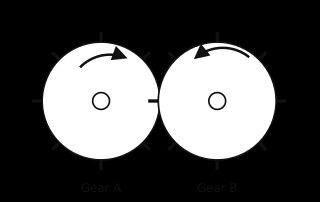
Two gears are meshed together, as shown below. Gear A has 40 teeth and Gear B has 20 teeth. If Gear A completes 1 full turn, how many turns does Gear B complete?
- A. 0.5 turns
- B. 1 turn
- C. 2 turns
- D. 4 turns
Correct answer: C
Explanation: Gear ratio = teeth on A / teeth on B = 40 / 20 = 2. The smaller gear turns twice for every one turn of the larger gear, and it turns in the opposite direction, as shown by the arrows.
Question 3
A pulley system uses one fixed pulley and one movable pulley to lift a load, giving a mechanical advantage of 2. Ignoring friction, if you pull 10 feet of rope, how far does the load rise?
- A. 20 feet
- B. 10 feet
- C. 5 feet
- D. 2 feet
Correct answer: C
Explanation: With a mechanical advantage of 2, the effort distance is twice the load distance, so the load rises half the rope length pulled: 10 / 2 = 5 feet.
Question 4
A shaft is connected to a motor through a belt-and-pulley drive. The drive pulley has a diameter of 4 inches and the driven pulley has a diameter of 8 inches. If the motor pulley turns at 1,200 RPM, what is the approximate speed of the driven pulley?
- A. 2,400 RPM
- B. 1,200 RPM
- C. 600 RPM
- D. 300 RPM
Correct answer: C
Explanation: Speed and diameter are inversely related in a simple belt drive: 1,200 x (4 / 8) = 600 RPM. The larger pulley turns slower.
Question 5
Which of the following best describes torque?
- A. The total weight of an object
- B. A twisting or rotational force applied at a distance from a pivot point
- C. The speed at which an object travels in a straight line
- D. The temperature of a moving part
Correct answer: B
Explanation: Torque is a rotational force equal to the applied force multiplied by the distance from the pivot (lever arm). It is not weight, linear speed, or temperature.
Electrical Knowledge
Question 6
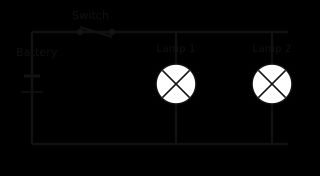
In the parallel circuit shown below, Lamp 1 and Lamp 2 are connected on separate branches between the same two points, with a switch in the main line. If Lamp 1 burns out, what happens to Lamp 2?
- A. Lamp 2 also goes out
- B. Lamp 2 stays lit, because each branch has its own path back to the battery
- C. Lamp 2 gets brighter and then goes out
- D. The switch must be replaced before Lamp 2 can light
Correct answer: B
Explanation: In a parallel circuit, each branch has an independent path. Losing one branch does not break the other branch’s circuit, so Lamp 2 stays lit as long as the switch is closed and the battery supplies power.
Question 7
Using Ohm’s Law (V = I x R), what is the current in a circuit with a voltage of 120V and a resistance of 24 ohms?
- A. 2 amps
- B. 5 amps
- C. 8 amps
- D. 12 amps
Correct answer: B
Explanation: I = V / R = 120 / 24 = 5 amps.
Question 8
Three appliances are connected in parallel on a 120V circuit: Appliance A draws 600W, Appliance B draws 480W, and Appliance C draws 240W. If all three operate at the same time, what is the total current draw, and what is the minimum standard fuse rating that safely exceeds it?
- A. 9A total current; a 10A fuse
- B. 11A total current; a 15A fuse
- C. 15A total current; a 20A fuse
- D. 18A total current; a 20A fuse
Correct answer: B
Explanation: Current for each appliance = P / V. A: 600/120 = 5A. B: 480/120 = 4A. C: 240/120 = 2A. Total = 5 + 4 + 2 = 11A. The fuse rating must be above the total operating current, so 15A is the smallest standard rating listed that safely exceeds 11A.
Question 9
A technician needs to verify whether an electrical outlet is receiving voltage before starting any other troubleshooting step. Which tool is designed for that purpose?
- A. A tape measure
- B. A voltmeter or multimeter set to measure voltage
- C. A pipe wrench
- D. A torque wrench
Correct answer: B
Explanation: A voltmeter or a multimeter set to the voltage function is the correct instrument for confirming whether voltage is present at a point in a circuit.
Question 10
What is the main functional difference between AC (alternating current) and DC (direct current)?
- A. AC only exists in batteries, while DC only exists in wall outlets
- B. AC periodically reverses direction, while DC flows in one constant direction
- C. AC always has a higher voltage than DC
- D. There is no functional difference; the terms are interchangeable
Correct answer: B
Explanation: AC reverses direction periodically (as in most utility power), while DC flows in a single constant direction (as in most batteries).
Hydraulics and Pneumatics
Question 11
A hydraulic system uses Pascal’s principle: pressure = force / area. If a small piston with an area of 2 square inches applies a force of 50 pounds, what pressure (in psi) is transmitted through the fluid?
- A. 10 psi
- B. 25 psi
- C. 50 psi
- D. 100 psi
Correct answer: B
Explanation: Pressure = force / area = 50 / 2 = 25 psi. That same pressure is transmitted throughout the enclosed fluid.
Question 12
In the hydraulic system from Question 11, the transmitted pressure now acts on a large piston with an area of 10 square inches. How much force can that large piston produce?
- A. 25 pounds
- B. 100 pounds
- C. 200 pounds
- D. 250 pounds
Correct answer: D
Explanation: Force = pressure x area = 25 psi x 10 sq in = 250 pounds. This is the basic mechanical-advantage principle behind hydraulic jacks and lifts.
Question 13
Which valve type is generally best suited for precisely regulating a low flow rate, rather than fully opening or fully closing a line?
- A. Gate valve
- B. Check valve
- C. Needle valve
- D. Ball valve fully open
Correct answer: C
Explanation: A needle valve uses a narrow tapered plunger inside a small port, which allows fine, precise flow control. Gate and ball valves are typically better suited for unrestricted on/off flow, and a check valve only permits flow in one direction.
Question 14
A pneumatic system loses pressure gradually over several hours even though the compressor cycles normally. What is the most likely explanation, and what is the appropriate first step?
- A. The air is too clean; add contaminants to build pressure
- B. There is likely an air leak somewhere in the lines or fittings; inspect and test for leaks following proper procedure
- C. The pressure gauge should be removed permanently
- D. Pneumatic systems always lose pressure and nothing should be done
Correct answer: B
Explanation: A slow, steady pressure loss with normal compressor cycling points toward a leak in the lines, fittings, or seals. The correct response is a systematic leak inspection using proper procedure, not ignoring the symptom or making unrelated changes.
Tools and General Maintenance
Question 15
Which tool is generally most appropriate for applying a specific, controlled amount of rotational force to a fastener, such as tightening a bolt to a manufacturer’s specification?
- A. A ball-peen hammer
- B. A torque wrench
- C. A pair of diagonal pliers
- D. A hand file
Correct answer: B
Explanation: A torque wrench is designed to apply and measure a specific amount of rotational force, which is important when a fastener must be tightened to an exact specification.
Question 16
A maintenance technician needs to check whether a rotating shaft is running true (without excessive wobble). Which basic measuring tool is best suited for this kind of check?
- A. A tape measure
- B. A dial indicator
- C. A level
- D. A caliper set to zero
Correct answer: B
Explanation: A dial indicator measures small amounts of movement or runout, making it the appropriate tool for detecting wobble or misalignment in a rotating shaft.
Question 17
Which of the following is a basic principle of routine preventive maintenance on rotating equipment?
- A. Wait until a part fails completely before performing any maintenance
- B. Follow scheduled lubrication, inspection, and adjustment intervals to reduce unexpected failures
- C. Remove all guards permanently to speed up future repairs
- D. Ignore unusual noises unless the equipment stops working
Correct answer: B
Explanation: Preventive maintenance relies on following scheduled lubrication, inspection, and adjustment intervals, which helps catch small issues before they cause equipment failure.
Question 18
A bolt is described as 3/8-16 UNC. What does the “16” refer to?
- A. The bolt’s total length in sixteenths of an inch
- B. The number of threads per inch
- C. The wrench size in millimeters
- D. The torque rating in foot-pounds
Correct answer: B
Explanation: In a standard thread designation such as 3/8-16 UNC, the second number indicates threads per inch. The first number is the nominal diameter, and UNC identifies the thread series.
Spatial and Schematic Reasoning
Question 19
The diagram below shows the TOP, FRONT, and RIGHT views of a solid stepped block. This is the same task style described in USPS’s own Exam 955 assessment materials for the Spatial Visualization section: you are given a drawing with top, front, and right views and must decide which option would produce all three matching views.

Based on this task style, which statement is correct?
- A. Only the FRONT view matters; TOP and RIGHT views can be ignored
- B. A correctly matching solid must produce all three views (TOP, FRONT, and RIGHT) at the same time, not just one of them
- C. The three views are always identical to each other
- D. Spatial Visualization questions never involve more than one view
Correct answer: B
Explanation: In this official Exam 955 question style, the correct answer must be consistent with every view shown at once. A solid that matches only one of the three views but not the others is not the correct match.
Question 20
Two flat puzzle pieces are shown with matching notch labels “P” and “P” on their edges. Which statement correctly describes how the pieces fit together in a Matching Parts and Figures item?
- A. Pieces are matched by color only, never by shape
- B. Pieces with matching labeled edges are intended to align edge-to-edge without gaps or overlapping
- C. Any two pieces of the same size will always fit together
- D. Matching labels indicate pieces that must never be joined
Correct answer: B
Explanation: In the official Matching Parts and Figures format, labeled edges show where pieces are intended to join, and the correct option shows the pieces fitted together without gaps or overlapping.
Question 21
A flat rectangular card is rotated 90 degrees clockwise in the plane of the page. If the card originally had its longer side horizontal, what is true after the rotation?
- A. The longer side is now vertical
- B. The card becomes a square
- C. The card disappears from view
- D. Nothing changes
Correct answer: A
Explanation: A 90-degree rotation exchanges the horizontal and vertical orientation of a rectangle, so a horizontally long card becomes vertically long.
Question 22
A wiring schematic uses a standard symbol for a switch and a separate standard symbol for a fuse. Why is it important to be able to distinguish between these two symbols before working on a system?
- A. Because switches and fuses always look identical, so distinguishing them is unnecessary
- B. Because a switch and a fuse serve different functions in a circuit, and misreading a schematic could lead to an incorrect assumption about how the circuit behaves
- C. Because fuses are only used in spatial reasoning questions, not real circuits
- D. Because schematic symbols have no standard meaning
Correct answer: B
Explanation: Standard schematic symbols exist so that technicians can correctly identify components and their functions. Confusing a switch symbol with a fuse symbol could lead to an incorrect understanding of how a circuit is protected or controlled.
Troubleshooting
Question 23
A motor that normally starts smoothly now hums but does not turn when switched on. Which of the following is the most reasonable first troubleshooting step?
- A. Immediately disassemble the motor housing
- B. Check the power supply, connections, and any obvious mechanical obstruction before further disassembly
- C. Replace the motor without further checks
- D. Ignore the humming since the motor is still receiving power
Correct answer: B
Explanation: Sound troubleshooting starts with the simplest, least invasive checks first, such as verifying power and connections and checking for an obvious obstruction, before moving to more invasive steps.
Question 24
A piece of equipment trips its circuit breaker every time it is switched on. Which of the following is the most likely general category of cause?
- A. Normal operation; no cause is needed
- B. An electrical fault such as a short circuit or an overloaded circuit
- C. The equipment is too clean
- D. The breaker box was painted recently
Correct answer: B
Explanation: A breaker that trips immediately on startup most often points to an electrical fault, such as a short circuit or an overload, rather than a cosmetic or unrelated cause.
Question 25
A conveyor belt is running slower than its rated speed even though the drive motor appears to run at normal speed. Which of the following is a reasonable area to inspect next?
- A. The color of the belt
- B. Belt tension, pulley condition, and possible slippage between the belt and the drive pulley
- C. The paint on the equipment frame
- D. The building’s front door
Correct answer: B
Explanation: When motor speed appears normal but belt speed is reduced, slippage caused by belt tension or pulley wear is a reasonable mechanical area to inspect, rather than unrelated cosmetic features.
Question 26
A pressure gauge on a compressed air system reads zero, but the compressor sounds like it is running normally. What is a reasonable next troubleshooting step?
- A. Assume the compressor is broken and replace it immediately
- B. Check whether the gauge itself is faulty and check for a major leak or blockage before replacing major components
- C. Ignore the gauge reading since sound is more reliable
- D. Disconnect all safety devices to see if the reading changes
Correct answer: B
Explanation: A zero reading with a normally running compressor could indicate a faulty gauge, a major leak, or a blockage. Checking simpler possible causes before replacing major components follows sound troubleshooting practice.
Safe-Work Judgment
Question 27
While working on a piece of equipment, you realize the task requires a procedure you were not trained to perform. What is the best course of action?
- A. Attempt the procedure anyway since you are already on-site
- B. Stop and request guidance or a qualified coworker before continuing
- C. Guess based on similar equipment you have worked on before
- D. Complete the task quickly so no one notices
Correct answer: B
Explanation: Safe work practice means stopping and seeking proper guidance or a qualified person when a task falls outside your training, rather than guessing or proceeding without authorization.
Question 28
You are asked to work on equipment that may still be energized. What is the correct general safety principle to follow before starting work?
- A. Assume equipment is de-energized unless it feels warm
- B. Follow your facility’s lockout/tagout and verification procedures before beginning work
- C. Work quickly to minimize exposure time
- D. Ask a coworker to hold the switch off manually instead of using lockout/tagout
Correct answer: B
Explanation: Proper lockout/tagout and verification procedures are the standard safe-work principle for equipment that may be energized. This page does not provide the specific lockout/tagout steps for any system; always follow your employer’s official safety procedures and training.
Question 29
You notice a coworker bypassing a required safety guard to finish a repair faster. What is the most appropriate response?
- A. Help them finish faster
- B. Say nothing since it is not your equipment
- C. Report the safety concern through the appropriate channel and avoid participating in the unsafe shortcut
- D. Remove the guard yourself to save time next time
Correct answer: C
Explanation: Safe-work judgment favors reporting safety violations through the proper channel and not participating in unsafe shortcuts, rather than ignoring the issue or joining in.
Question 30
A written maintenance procedure requires two signatures before a specific repair can begin. Only one signature has been obtained, and a supervisor is not immediately available. What should you do?
- A. Begin the repair anyway since it is only a formality
- B. Wait and follow the required procedure exactly, obtaining the second signature before starting
- C. Sign the second signature yourself
- D. Skip the procedure permanently for this repair
Correct answer: B
Explanation: Written procedures with required approvals exist for safety and accountability reasons. The correct response is to follow the procedure exactly rather than bypass, forge, or permanently skip a required step.
USPS Exam 955 Practice Answer Key
- B
- C
- C
- C
- B
- B
- B
- B
- B
- B
- B
- D
- C
- B
- B
- B
- B
- B
- B
- B
- A
- B
- B
- B
- B
- B
- B
- B
- C
- B
How to Score This Practice Set
- 26-30 correct: Strong baseline across mechanical, electrical, spatial, and judgment areas.
- 20-25 correct: Good readiness. Review the categories where you missed the most questions.
- 14-19 correct: Moderate readiness. Practice hydraulics, pneumatics, electrical basics, and spatial visualization separately.
- 8-13 correct: Needs improvement. Build foundational mechanical and electrical knowledge before adding time pressure.
- 7 or fewer correct: Start with untimed review of basic mechanical and electrical concepts.
This scoring guide applies only to the 30 unofficial practice questions on this page. It is not the official USPS Exam 955 score, passing threshold, ranking method, or hiring outcome. The official passing score, published by USPS, is a minimum of 70 (excluding Veterans’ Preference points) on the actual examination.
How to Prepare for USPS Exam 955
- Confirm the exact exam number on your own USPS job announcement and assessment invitation.
- Read the official USPS Assessment Information Package for Exam 955 in full.
- Review basic mechanical concepts: gears, pulleys, levers, torque, and mechanical advantage.
- Review basic electrical concepts: Ohm’s Law, series versus parallel circuits, AC versus DC, and common test instruments.
- Review hydraulics and pneumatics fundamentals: pressure, force, area, and common valve types.
- Review common maintenance tools and basic preventive-maintenance principles.
- Practice spatial visualization: matching parts and figures, and identifying a solid from its top, front, and right views.
- Practice reading simple troubleshooting scenarios and selecting the most reasonable next step, not the most extreme one.
- Review safe-work judgment scenarios that emphasize following procedure, escalating appropriately, and not bypassing safety steps.
- Take timed mixed practice once you are comfortable with each area individually.
- Arrive at your test center with a government-issued photo ID and your assessment login credentials, as required by the official USPS instructions.
Common Mistakes
- Assuming Exam 955 is the same test as the mail carrier or mail handler VEA exams (474, 475, 476, 477)
- Treating a preparation provider’s content-area breakdown as an official USPS specification
- Guessing an exact retest wait period instead of confirming it through your official Notice of Result
- Skipping items on the Multicraft section instead of guessing, even though there is no guessing penalty
- Confusing series and parallel circuit behavior
- Reversing the direction of a driven gear or pulley
- Matching only one of the three views (top, front, right) instead of all three at once
- Choosing an extreme troubleshooting response instead of the simplest reasonable first step
- Assuming a passing score guarantees selection, when a structured interview and other steps also apply
- Relying only on a static PDF without practicing timed spatial-reasoning questions
Free vs Paid Preparation
Free preparation can help you understand the exam’s two-part structure, review basic mechanical and electrical concepts, and try practice-style questions across the seven skill areas covered on this page.
Independent mechanical aptitude practice on AptitudeTests.org can supplement your review of general mechanical reasoning skills such as gears, levers, and pulleys. It is general mechanical aptitude preparation, not a USPS-specific or Exam 955-specific product, and it does not reproduce the Multicraft or Spatial Relations content of the real exam.
JobTestPrep and AptitudeTests.org are independent third-party preparation providers. Neither is the United States Postal Service, PSI, GEN2, or the official Maintenance Selection System administrator. Preparation cannot guarantee a passing score, an interview, or a hiring outcome.
Official resources
- USPS Postal exams
- Official Exam 955 Assessment Information Package (PDF)
- APWU Maintenance Selection System Handbook, EL-304 (PDF)
- USPS Practice Tests hub
These official and union sources describe the current exam structure and the Maintenance Selection System process. They do not define a fixed, unofficial content-area breakdown, and this page does not present one as official.
Related Guides
- USPS Practice Tests
- Federal Hiring Tests
- Mechanical Aptitude Tests
- Mechanical Aptitude Test
- Hydraulics Questions
- Pneumatics Questions
- Tools and Workshop Questions
- Electrical Circuits Questions
- Spatial Reasoning
- Maintenance Technician Test
- Industrial Maintenance Test
FAQ
What is USPS Exam 955?
USPS Exam 955 is the examination component of the USPS Maintenance Selection System. It is used to screen applicants for maintenance craft positions such as maintenance mechanic, building equipment mechanic, and electronic technician.
Is Exam 955 the same as the USPS mail carrier exam?
No. Mail carrier and related roles use separate Virtual Entry Assessment exams (474, 475, 476, 477). Exam 955 is specific to maintenance craft positions.
What does Exam 955 cover?
The official USPS assessment package describes two timed parts: Multicraft (60 items, 60 minutes, covering mechanical and electrical job skills) and Spatial Relations (visual spatial relations ability). The same package gives conflicting Spatial Relations item-count and timing figures (68 items in 40 minutes in the summary table, and 65 items in 60 minutes in the explanatory passage), so follow the count and timer shown in your live assessment session.
What is the passing score for Exam 955?
USPS’s own official assessment package states that a minimum score of 70, excluding Veterans’ Preference points, is required to be considered for the positions you applied for.
What happens if I do not pass?
Multiple independent sources report an “Ineligible” result with a waiting period before retesting, commonly cited as around six months. Confirm your exact retest timeline through your official USPS Notice of Result or your local Human Resources office.
Does passing Exam 955 guarantee a maintenance job?
No. USPS combines your exam result with a structured interview and other steps, such as background review, before making a final selection.
Are these official USPS questions?
No. Every question on this page is an original practice-style example. They are not official USPS, Maintenance Selection System, or testing-vendor questions.
Is JobTestPrep the official USPS test provider?
No. JobTestPrep is a third-party preparation company. It is not USPS, PSI, GEN2, or the official Maintenance Selection System administrator.